Aviation
Commercial /
Europe
Concorde, the supersonic
Second supersonic airliner and first successful
Concorde G BOAC
Britsh Airways
CC by SA-3.0 http://www.airliners.net/photo/British-Airways/Aerospatiale-BAC-Concorde-
Rafael
2/28/2021
A little more than 50 years ago, a commercial plane was capable of flying at more than 2100 km / h and altitudes never seen by commercial planes (60 thousand feet at cruising altitude). In 1965 a Franco-British union gave life to the design of the hang glider aircraft that would make history. In 1969, the first take off of the Concorde began. In 1976, this plane made its first commercial flight.
Since the 1950s, it was thought to overcome the sound barrier in a commercial airplane. At that time, prototypes that fulfilled this function were produced in order to study the technical characteristics necessary for this feat. These tests resulted in the Avro 730 and the Handley HP 115.
The British knew that the French were looking for a supersonic commercial aircraft, and so they joined forces to carry it out. The French improved the design, while the British got the engine needed to take the jet at speeds greater than that of sound, so the speed was limited to mach 2.0 (2400 km / h), because, above that, the aluminum used in the fuselage could not take it. Furthermore, the temperature in his nose became very high at such a speed (above 100 ° C).
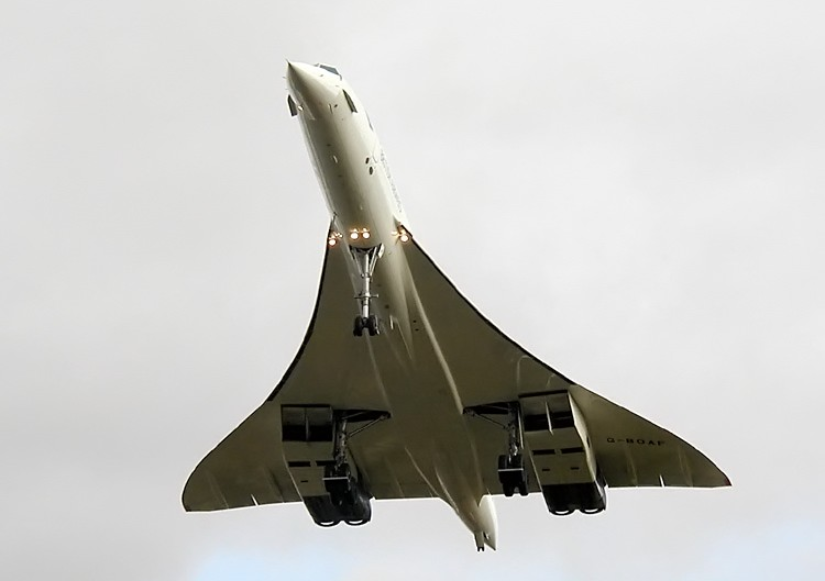
Concorde G-BOAF
Concorde em seu último voo
Many companies have shown interest in purchasing this aircraft, but the project was very expensive, costing up to 23 million Euros per unit. Another aggravating factor for Concorde was that the industry was becoming increasingly ecological and economical, mainly because of the oil crisis of the 1970s. Thus, in 1973, the only orders that remained were those of BOAC (which became Britsh Airways) and Air France.
There was also the aggravating factor in the fall of the Tupolev TU-144 and the noises produced by the Concorde, which were very large when crossing the sound barrier.
Concorde G-BOAF
Concorde em seu último voo
On July 25, 2000, the Concorde suffered a serious accident when, when taking off, a tire burst and threw its pieces under one of the plane's wings. Due to the impact, the fuel tank ruptured, causing the fuel to fall into the engine in full post-combustion. The crew tried to maintain the climb with the use of the other engine, but it was not possible. It was then that the Concorde lost support and fell, causing the death of 100 passengers, 9 crew members and 4 more deaths on the ground.
The concorde flew back with some changes to his project in 2001, but it didn't last long. His last flight was on October 24, 2003.
Hyperlinks: