Aviation
Commercial /
Brazil
CBA-123
The sophisticated Embraer turboprop in partnership with Argentina that has never been built
CBA-123, destaque para o motor virado para trás
o que permitia um menor nível de ruído interno
Divulgação/Embraer
Rafael Ramos
4/27/2021
In 1986, Presidents José Sarney, from Brazil, and Raul Afonsin, from Argentina, signed a cooperation agreement to expand partnerships between the two countries. The commander of the Argentine Air Force (FAA) visited Embraer's facilities and suggested cooperation between the two countries for the development of a commercial aircraft. At the time, the Brazilian manufacturer was targeting the regional aviation market and had plans to create an airplane that would replace the EMB-110 Bandeirante.
The partnership was closed and soon, in May 1987, Embraer and Fabrica Militar de Aviones (FMA), got together to make the project a reality.
The specifications that the aircraft should have were as follows: pressurized cabin, space for up to 19 occupants, high safety standards and two turboprop engines. The program was based on the EMB-120 Brasília platform. Embraer called the aircraft EMB-123, however, to demonstrate the association between the two countries, the aircraft received the name CBA-123, whose acronym stands for Cooperation Brazil Argentina.
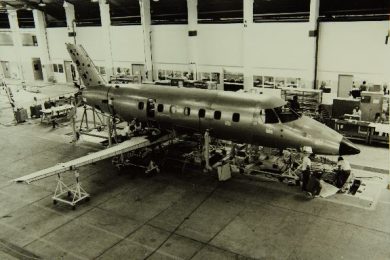
CBA-123 na linha de montagem
Divulgação/Embraer
The new plane was nicknamed Paraná by the Argentines and Tapajós by the Brazilians. However, the model should be recognized worldwide, since the program's objective was to reach the international market. Then a name was chosen that would be easy to pronounce in the world. The name was Vector.
The $ 300 million workload was divided, 70% for Embraer and 30% for FMA. Two assembly lines for the aircraft were created. One in São José dos Campos (Brazil) and the other in Córdoba (Argentina).
The differentiated plane was presented on July 30 in São José dos Campos (SP), and was attended by the then president of Brazil, Fernando Collor de Mello and the one of Argentina, Carlos Menem. What attracted the most attention in the design were the turboprop engines turned backwards, in the “pusher” configuration.
Roll-Out do CBA-123
Divulgação/Embraer
Flight performance was good for the time. The maximum speed reached 612 km / h and the autonomy reached 1800 km. These figures served the regional aviation market of the 1990s well.
Since 1991, the project has been interrupted several times. The CBA-123 was sophisticated and advanced and required a lot of investment. At the time, Embraer was experiencing financial difficulties and, to make matters worse, FAMA too, which made it difficult to transfer funds to the joint project. Another aggravating factor was the oil crisis of 1990.
In 1992, the CBA-123 project was officially canceled. Embraer and FAMA had signed an initial contract to acquire a total of 60 aircraft, but only two prototypes were produced and, with the program deactivated, they were dismantled.
The specimens underwent a restoration process as part of Embraer's 40th anniversary celebrations. The revitalization of the aircraft ended in May and July 2009. Today the aircraft are on display in museums.
The CBA-123 brought knowledge to the company and helped in the construction of the ERJ-145, which helped elevate the Brazilian company to the position of the third largest aircraft manufacturer in the world, behind only Boeing and Airbus.
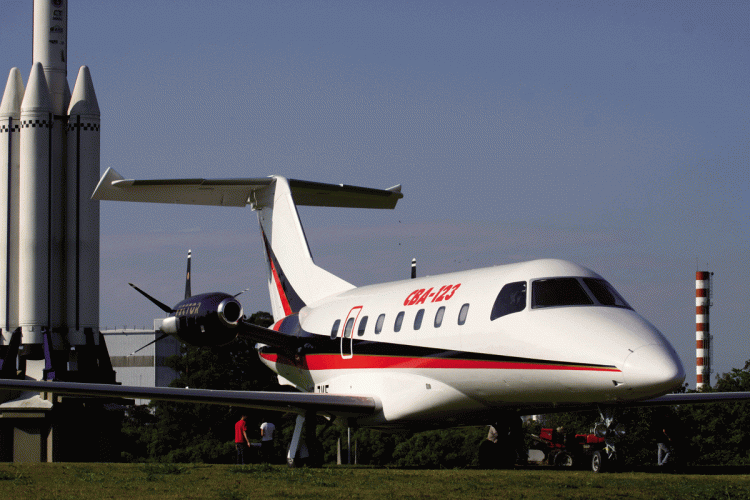
CBA-123 exposto no Memorial Aeroespacial Brasileiro
Divulgação/Embraer
Hyperlinks:
 Rafael Ramos
Aviation enthusiast from an early age, he had his first contacts with the area developing that good old habit of spending dozens of hours in front of the screens of Micrsoft Flight Simulator and other simulators. With a solid background in various technological areas, including engineering and chemistry, Rafael has rejoined aviation as editor and author of articles and materials on our portal, providing invaluable help to the dynamics and expansion of the website and the aeronautical community, bringing us the news and updates so indispensable for us to remain current in our area of operation.
   
|