Technology
Aeronautics /
Europe
Energy challenge
Switzerland invests in research for sustainable fuel development
Rafael Albornoz/Unsplash
Gabriela Ramos
5/5/2021
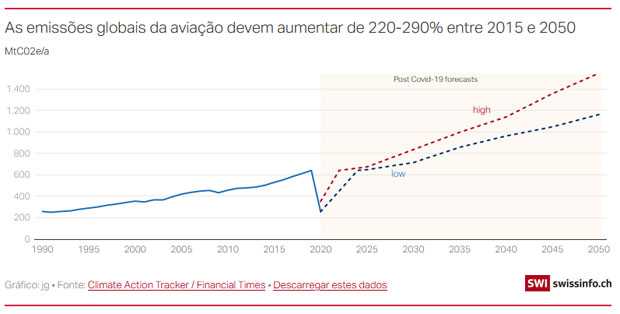
Swiss research institutes are initiating studies for the development and production of fuel from renewable resources, since aviation is one of the sectors that emits more carbon dioxide today, being responsible for up to 3% of CO2 emissions in the world, despite the initiatives to change this, such as investment in the use of SAF (Sustainable Aviation Fuel) and electric aircraft projects. There is an expectation that in the coming years this percentage will increase even more, and may triple by 2050, as a consequence of an increase in the demand for flights. However, for a change to occur, several other measures will have to be adopted worldwide. One of the major challenges is the production of fuel on a large scale.
On a round trip, for example, from London to San Francisco, approximately one ton of CO2 is emitted per passenger, which would be equivalent to what a diesel car would emit if it drove more than 3,700 miles (approximately 5,900 kilometers).
One of the biggest bets to change this scenario in the medium term is the investment in SAF, the sustainable aviation fuel, which reduces carbon emissions by up to 80% compared to ordinary fuel. SAF can be produced from biomass, plants, palm and cooking oils, solid waste and even sunlight.
Despite this, SAF is very little used today, having represented less than 0.01% of the fuel consumed by aviation in 2018. This is mainly because of its high cost and, thus, ends up being used by few airlines and still mixed with conventional fuel.
However, the International Air Transport Association (IATA), a global organization that supports aviation with global standards for airlines in safety and sustainability, aims to encourage a massive increase in the use of SAF by 2025, encouraging more companies to join, including outside the aviation sector, and also developing ways to produce more sustainable fuels at more affordable prices.
Thus, Empa (Swiss Federal Materials Science and Technology Laboratories) and the Paul Scherrer Institute publicized the “Synthetic Fuels” research initiative, aiming to study and find new ways of producing SAF. The project will cost 6.2 million Swiss francs, equivalent to $ 6.5 million.
Tim Dennert/Unsplash
According to Peter Jansohn, a researcher at the Paul Scherrer Institute, “sustainable drop-in fuels - that is, aviation fuels that can be placed in tanks without having to make changes to the aircraft - are the ideal transition path. (...) These fuels will make a considerable contribution to reducing CO2 emissions from aviation ”.
Björn Niesen, also a researcher at the institute, says that “alternative aircraft propulsion systems, such as hydrogen and batteries, which are still very heavy for long-haul flights, will take a long time to be developed and certified. So, we really need to have a solution like sustainable aviation fuels. There is no other quick alternative ”.
The idea is that this research is able to develop new ways of producing fuel, through the study of techniques used today and also new techniques. The fuel production process is through the combination of hydrogen from renewable sources and carbon dioxide, which can be obtained in several ways. According to Niesen, the most common today is the use of dimethyl ether and methanol, but Empa is seeking to develop an ethylene-based process.
However, there are disagreements in relation to the use of SAF as a sustainable alternative, Greenpeace being one of the critics of sustainable fuels, as they claim that this would be a false solution, since they believe that the use of crops for biofuels would only put further pressure on ours. ecosystem.
For this reason, Jansohn says that it is necessary to take advantage of other carbon resources, recycling CO2 from different sources, in order to guarantee sufficient production of SAF in the future. However, this process is still very expensive, since it requires a lot of renewable electricity in its production, in addition to also having a carbon footprint.
In Switzerland, other partnerships were also made with a view to developing more SAF production methods, such as the partnership between Synhelion, a Swiss company that develops solar fuel, and the Lufthansa Group. Synhelion uses sunlight and air to produce carbon-free fuels.
In September 2020, the Air Transport Action Group, ATAG, released the document Waypoint 2050, where it reports that, to meet the goal of zeroing carbon emissions by 2050, it would be necessary to produce between 450 and 500 million tons per year until then, and currently production is 64 thousand tons per year. Achieving this goal is the biggest challenge, but according to the document, the goal is “far from being insurmountable”, and can be achieved through “strict sustainability criteria”, and by production that uses a “range of raw materials from non-food crops to waste sources and, eventually, a switch to energy fuels for liquids made from recycled or directly captured low-carbon CO2 ”, in order to diversify production.
Reprodução/Defesanet
In addition, individual actions and government policies can also assist in this process. As an example, Switzerland passed a carbon tax on airfares in September, which will go to a climate fund and SAF production.
Another example of government policies is that of Brussels, which aims to introduce a mandatory SAF quota for airlines. However, companies have shown themselves to be resistant to this plan, since the cost of SAF is still very high, which would probably bring losses to companies, even more in the crisis scenario caused by the pandemic. Despite this, Boeing and Airbus said that by 2030 they will manufacture airplanes capable of flying only on sustainable fuel.
Empa and the Paul Scherrer Institute stated that several sectors have shown interest in the project, such as the Swiss Federal Civil Aviation Office and the Department of Defense, although there is still no official partnership.
According to Niesen, “we are not that far. We have the technology and the development to scale it to a size where we can produce large quantities of fuel. (...) The idea is really to prepare for the stage where we can talk with industrial partners to establish pilot projects and systems ”.

Hyperlinks:
...
...
...
 Gabriela Ramos
Gabriela is the latest addition to the editorial team of our website, having provided us with her solid background in editing, publishing and photography, and her interest and training in aviation history and historiography. His good taste and common sense and great cleverness and sagacity in the selection of themes and materials greatly enriched our vocabulary and narrative style. Gabriela brought unusual predicates and came to stay, helping to point the way of success of our portal.
   
|