Technology
Aeronautics /
Europe
Zero emissions
Airbus hopes to replace kerosene and achieve clean aviation through the use of hydrogen
Airbus ZEROe
Image: Airbus
Rafael Ramos
5/6/2021
Airbus plans to fly its commercial hydrogen-powered aircraft in 2035 and believes that the new fuel could completely replace kerosene, leading to zero-emission aviation.
This is how the vice president of zero-emission aircraft at Airbus, Glenn Llewellyn, idealizes. The project led by the vice president has three aircraft under development. All prototypes use hydrogen as their primary energy source.
However, the goals of the Paris Agreement to reduce the environmental impact could not be achieved without the use of hydrogen. Thus, hydrogen is the most promising solution to mitigate the climate impact of aviation. CO2, NOx and trace elements from burning fossil fuel can be significantly reduced.
This would be a solution to problems in the short and medium term. Hydrogen has the potential to be the best way to do this, but the success of the technology would depend on the widespread use of hydrogen in economies. In addition, renewable energies, such as wind and solar, should continue to reduce their costs. The cost of electricity would be another critical factor in obtaining hydrogen at a low cost.
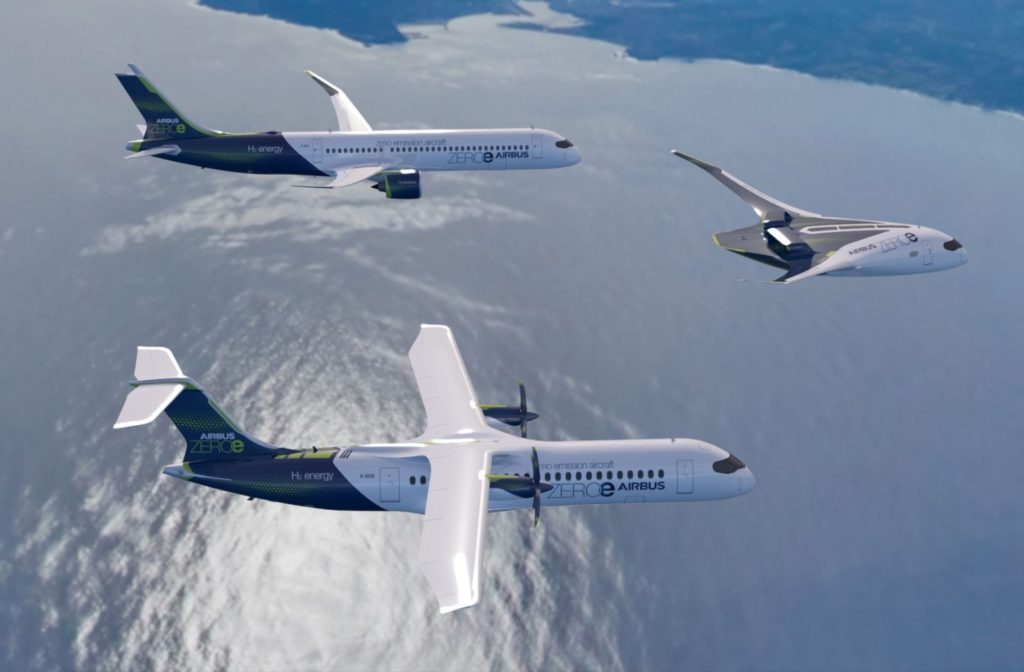
Conceito de aeronaves sem emissões
Airbus ZEROe, movidos a hidrogênio
Divulgação/Airbus
If hydrogen is obtained from renewable energy through electrolysis, it produces no emissions. That would be the solution for sustainable aviation.
The vice president expected hydrogen to significantly lower its costs of obtaining and storing it as its production increased on a large scale in transportation. Thus, the fuel would become increasingly competitive in terms of costs with the existing options, such as aviation kerosene.
According to Llewellyn, Airports should also start using hydrogen to decarbonize their ground transportation system, thus allowing the use of hydrogen to expand and airports to prepare to receive future hydrogen aircraft in the mid-2030s, but they must also act as hydrogen centers serving neighboring cities.
Each Airbus ZEROe concept represents a different approach to achieving zero-emission flights, exploring various technology paths and aerodynamic configurations to support the company's ambition to lead the way in decarbonizing the aviation industry.
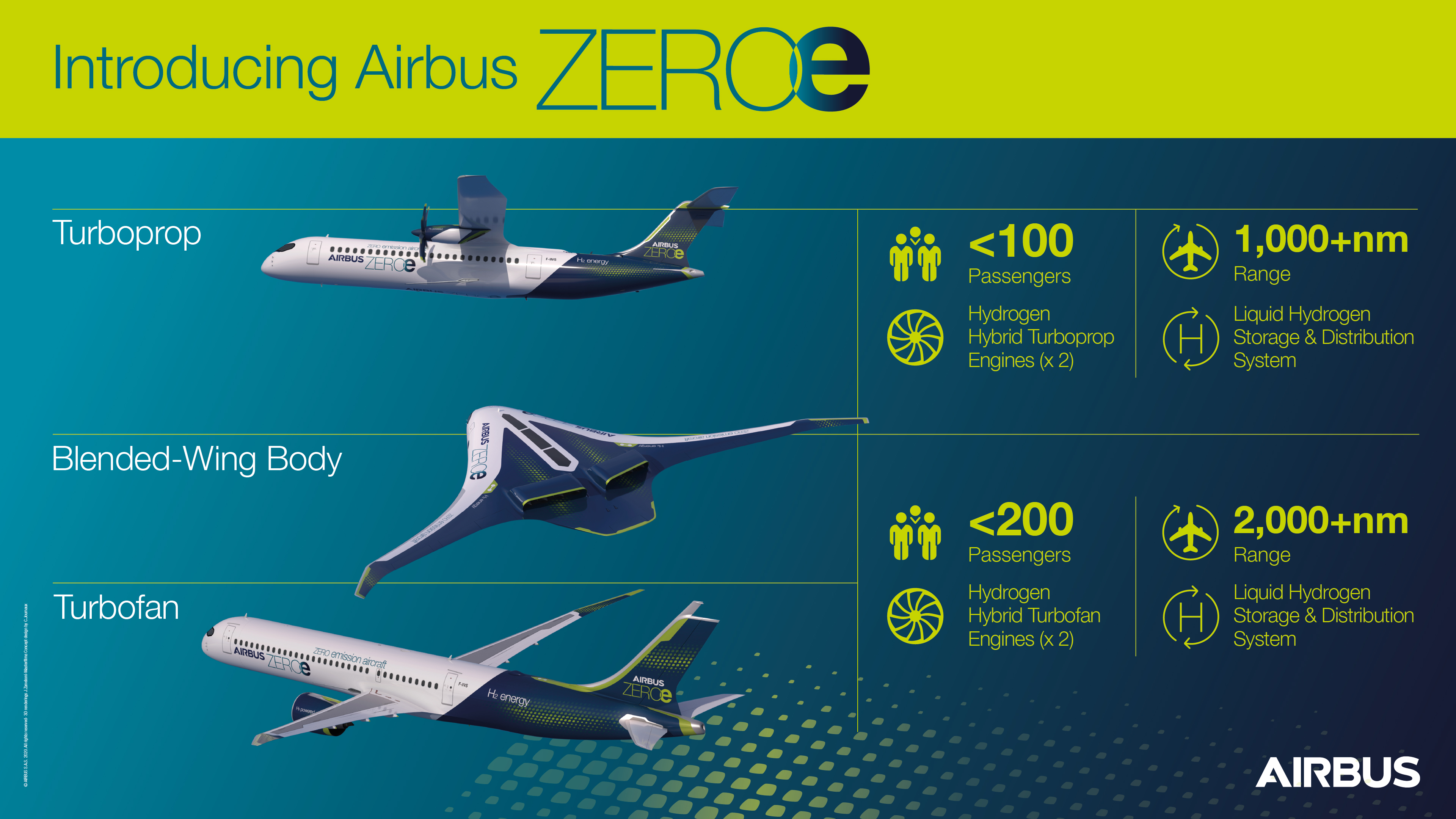
Airbus ZEROe
Image: Airbus
One project is a turbofan for less than 200 passengers powered by hydrogen combustion with a range of more than 2,000 nautical miles. It could operate intercontinental routes.
The other project is a turboprop with a capacity of up to 100 passengers. The turboprop engine is powered by hydrogen combustion in modified gas turbine engines with a range of more than 1,000 nautical miles for short trips.
The last project would be a mixed-wing body plane with a capacity for less than 200 passengers. Its wide cabin layout opens up several options for hydrogen storage and distribution.
Airbus will invest millions of euros by 2025 to determine which aircraft it should bring to the market first. Then, that investment would rise to many billions, added Llewellyn.
Hydrogen storage tanks are larger and heavier than today's fuel tanks. Thus, it is necessary to find innovative ways to store these tanks on aircraft.
"Hydrogen is safe and non-toxic - neither more nor less dangerous than other fuels, including gasoline and natural gas," he said.
However, security is an important factor. "It is mandatory to achieve the same or better safety targets than we do with existing commercial aircraft."
With all these challenges, other manufacturers are planning a commercial hydrogen powered aircraft for 2050, however, in Llewellyn's words, Airbus wants to do this before, since it is the type of urgent aviation solution. Llewellyn also said that Airbus is working with all engine manufacturers, without whom it would not be possible to make this kind of change in the industry.

Hyperlinks:
...
...
...
 Rafael Ramos
Aviation enthusiast from an early age, he had his first contacts with the area developing that good old habit of spending dozens of hours in front of the screens of Micrsoft Flight Simulator and other simulators. With a solid background in various technological areas, including engineering and chemistry, Rafael has rejoined aviation as editor and author of articles and materials on our portal, providing invaluable help to the dynamics and expansion of the website and the aeronautical community, bringing us the news and updates so indispensable for us to remain current in our area of operation.
   
|