Aviation
Military /
USA
The Cadillac of the skies
Get to know the history of the P-51, one of the most important aircraft that fought in World War II
P-51D
Daniel Eledut/Unsplash
Gabriela Ramos
5/21/2021
During World War II, in the years when the P-51 was created and introduced into combat, the conflict was stagnant, neither side was able to advance further in its intentions. So, in 1940, a step is taken towards resolving this issue: the development of one of the most advanced fighters of the time, the P-51, the bomber that revolutionized the war, begins.
Not only to continue the combat, but also because the fighters that existed until then, which aimed only to defend territories through aerial combat, were not able to escort bombers, which attacked other territories. For this reason, American bombers were highly vulnerable, as these aircraft had to travel from England to Germany to carry out the bombing and return, without an escort. The problem is that this route would add up to approximately 3,000 kilometers, and no aircraft was able to fly even close to that.
So, although it was initially designed as a medium-altitude fighter for the British, in 1942 the P-51 Mustang debuted in World War II by the United States Air Force.
The fighter, in addition to escorting American bombers to Germany, also operated by attacking and dropping bombs, having been recognized for blowing up enemy trains, ships and facilities in Europe and plaguing the defenses of the Axis countries. But the great highlight of its performance was the escort, since it managed to reduce the losses of American fighters a lot, a factor that transformed the face of the war and was decisive for the success of the Allies.
The P-51 was able to deeply penetrate enemy territory both in escort, defensive and offensive operations, as well as in direct attacks on German fighters within its own territory, having been a determining factor in the failure of the Luftwaffe and industrial power. German.
The fighter was also used in the Pacific War and in 1944 carried out attacks on Japanese fighters and, in 1945, again served as an escort to American bombers. One of the Japanese counterattacks in this conflict even went to a P-51 pilot camp.
The manufacturer North American Aviation was responsible for the development of the Mustang, which flew for the first time on October 26, 1940 with the North American prototype NA-73X. The P-51 operated until 1984 and was also used (and equally decisive) in several other conflicts, such as the Korean War, for example; and it has also been adopted by other air forces around the world.
In 1944, the Truman Committee classified the Mustang as "the most aerodynamically perfect pursuit plane in existence".
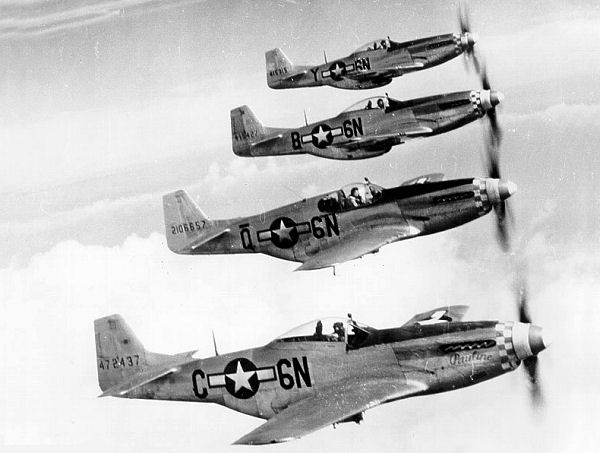
Quarteto de P-51 do 339º grupo de caça
assumed USAAF, Public domain, via Wikimedia Commons
The P-51 is a single-seat, single-engine plane with a piston engine, which also favored it in the war, as it made it very fast. The engine was a 12-cylinder Rolls Royce, and the tailpipes were on the sides. Its maximum speed was approximately 390 miles per hour (600 km / h), and its combat range was approximately 750 miles (1,200 km), a number that almost doubled with the use of external drop tanks, reaching 1,375 miles (2,200 km) km). In addition, the maximum take-off weight was 5,490 kg and the aircraft's autonomy was 2,565 km. The operating ceiling was 41,900 feet (12,800 m). Another important factor was the retractable landing gear, a modern system for the time. These characteristics gave the fighter a good performance of acrobatics and maneuverability, having been innovative for its era.
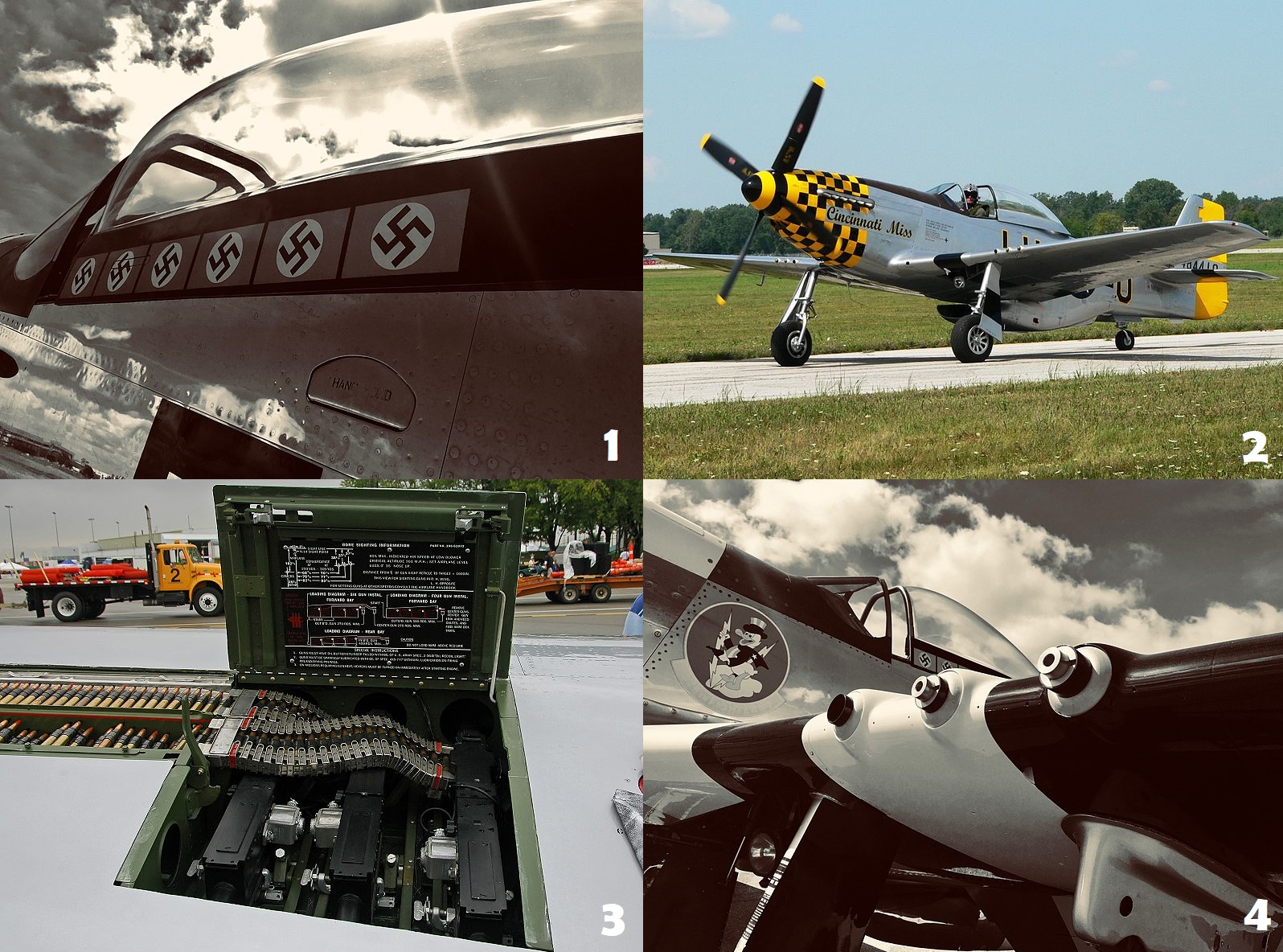
As for armament, the Mustang had three machine guns on each wing and the ammunition was inside the wings. Bombs were also attached to the wing.
The Mustangs' painting was abandoned at the end of the war, because as the United States saw itself close to victory, they no longer saw the need to camouflage planes. So, to avoid the cost of painting, they started to keep airplanes in the original color of polished aluminum, the color for which airplanes are known today. At that time, the aircraft had something written on the sides or some drawing or painting on the nose, usually done by the pilots themselves, who did it to sign some characteristic or personal customization.
In addition, flags were glued to the fuselage to indicate how many and which planes that Mustang had already shot down. For example, if an airplane has three Nazi flags glued to the fuselage, it would mean that it shot down three Nazi planes.
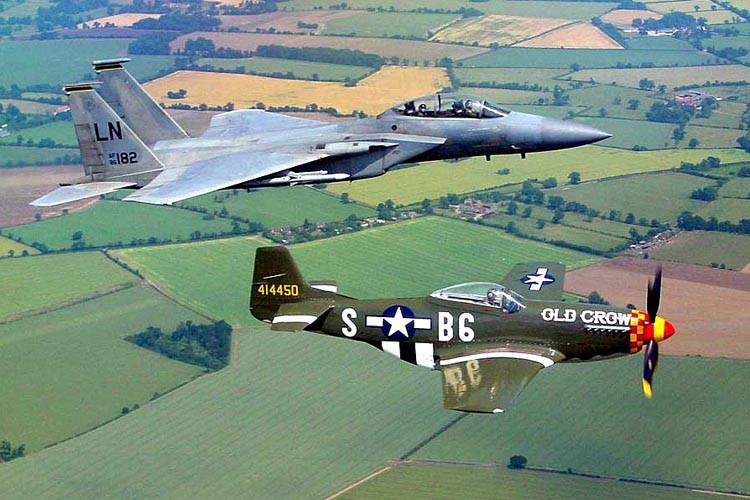
P-51 ao lado de um F-15
Domínio público, via Wikimedia Commons
The Mustang was the main fighter used by the United Nations at the beginning of the Korean War, but came to be used as a fighter-bomber for ground attacks after the F-86 took its leading role in this conflict.
More than 15,000 Mustang units have been built and more than eight versions of the aircraft have been produced. Thanks to the large quantity produced, many aircraft of this model started to be sold to civilians and transformed into racing airplanes (such as the Reno Air Race, for example), or demonstration and air show.
Currently, it is even possible to buy a P-51, although there is no model in Brazil.
It is also important to remember the Tuskegee Airmen (group of black fighter pilots) and the WASPs (Women Airforce Service Pilots - group of women who flew fighters for testing, transport and training other pilots), who performed important feats flying the Mustang.
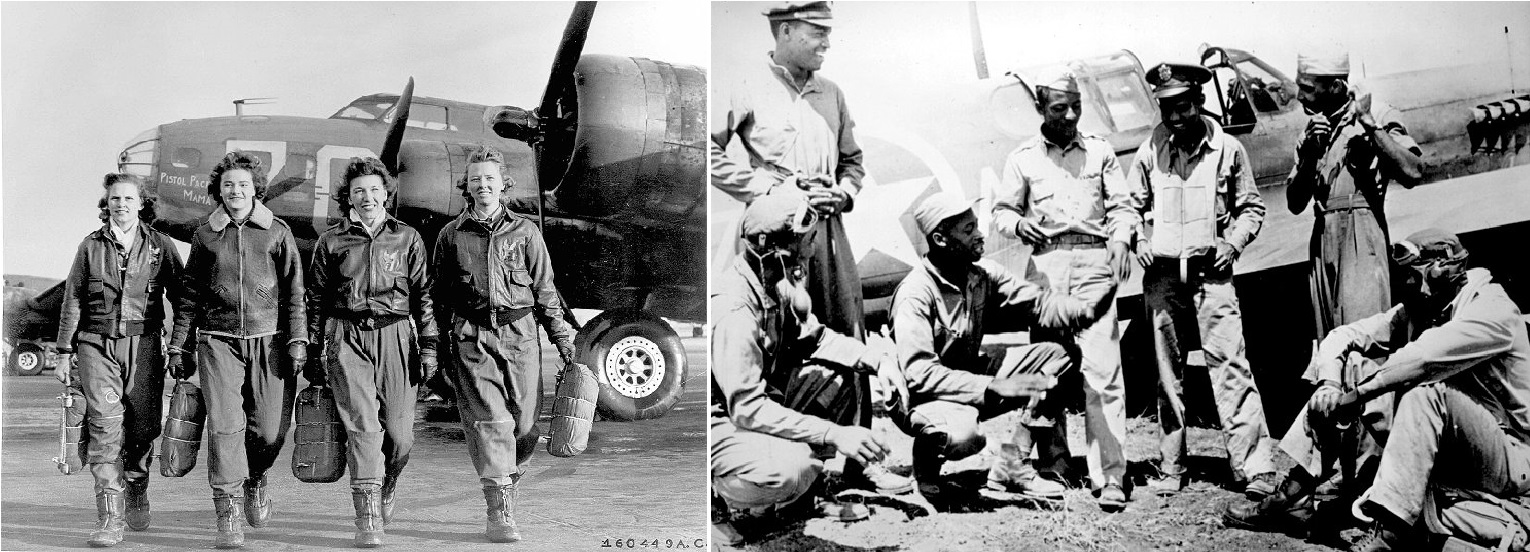
Pilotos do grupo Tuskegee Airmen (à direita) e pilotas da WASPs (à esquerda)
U.S. Air Force photo, Public domain (esquerda) / Domínio público (direita) / via Wikimedia Commons
Hyperlinks:
 Gabriela Ramos
Gabriela is the latest addition to the editorial team of our website, having provided us with her solid background in editing, publishing and photography, and her interest and training in aviation history and historiography. His good taste and common sense and great cleverness and sagacity in the selection of themes and materials greatly enriched our vocabulary and narrative style. Gabriela brought unusual predicates and came to stay, helping to point the way of success of our portal.
   
|