Technology
Aeronautics /
Europe
engine demonstrator
Testing of the future EcoPulse hybrid propulsion system successfully completed
Demonstrador EcoPulse
Divulgação/Airbus
Gabriela Ramos
6/13/2021
Daher, Safran and Airbus, supported by the French Civil Aviation Research Council (CORAC) and the French Civil Aviation Authority (DGAC), are developing the EcoPulse hybrid aircraft engine demonstrator and wind tunnel tests successfully completed at Airbus' UK facilities.
During the development phase, it will be analyzed if the systems operation is similar to that of computer simulations. To assess whether the result matches the one calculated above, full-size pieces and smaller-scale models are placed in a wind tunnel.
Airbus wind tunnel installation head Tim Axford said: “The EcoPulse wind tunnel tests allowed us to evaluate the performance characteristics of the propeller and the electric motor cooling process. To do so, we assembled the engine supplied by Safran, the Airbus nacelle and the propeller supplied by DUC Hélices, which will be installed in the demonstrator aircraft in the wind tunnel. We then use large, powerful fans to blow air (at different speeds) over and around the model. By doing this, we can take real measurements and capture real-time data.”
As for the propeller performance tests, Tim explains: “We looked at the different levels of power and revolutions per minute (RPM) of the engine, measuring the thrust and force on the propellers. We also look at the propeller 'belt' or airflow behind the engine. This gives us a set of experimental data to better understand the interaction between the propeller and the wing.”
As for the cooling of the electric motor, he states that “electric motors generate heat during operation, requiring a cooling system to reduce temperatures, both on the ground and in flight. In the wind tunnel, dedicated measurements of engine and air temperature were recorded to assess the effectiveness of cooling technologies.”
The information obtained from the tests in the wind tunnel will allow a more accurate assessment of the energy consumption of the propulsion system, which could improve the final performance of the aircraft demonstrator. Matthieu Scherrer, leader of the Airbus EcoPulse project, says that "precise propeller performance numbers will be taken into account for the creation of the Airbus Flight Control Computer software, being one of the next steps."
Then, the Critical Design Review (CDR) will be carried out, allowing the production of EcoPulse to begin. Ground tests are scheduled for 2022, and the first test flight is scheduled for the summer of the same year. The project was launched in June 2019.
Distributed propulsion systems work by dividing the thrust generation into several smaller engines located along the wing of the aircraft. Thus, it is possible to improve take-off and landing performance and reduce noise emissions, in addition to enabling a new concept of flight control.
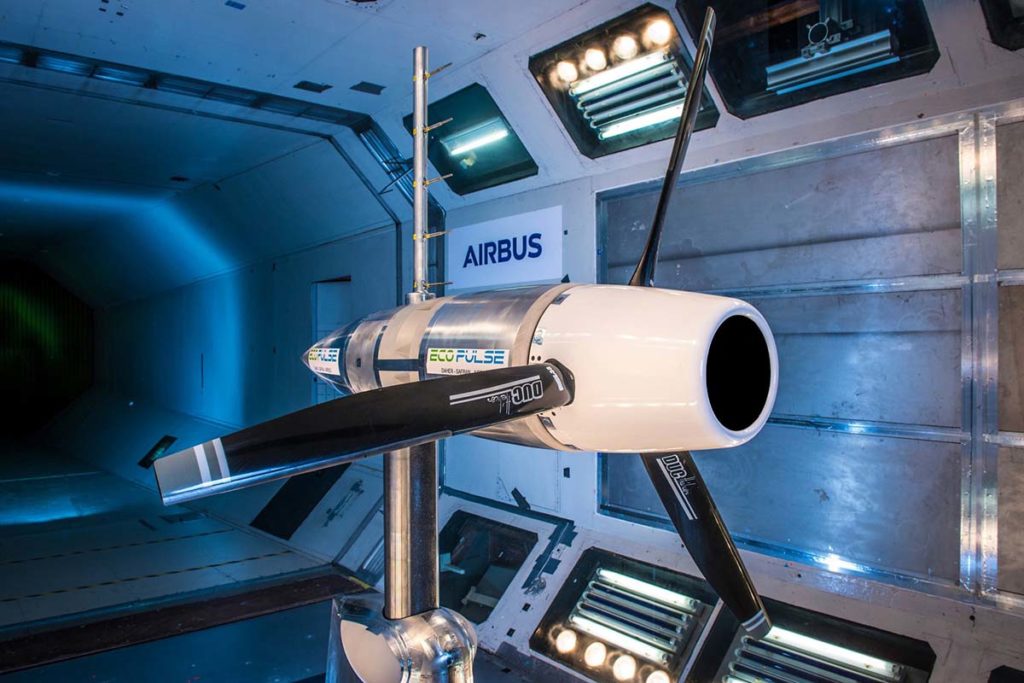
Demonstrador EcoPulse
Divulgação/Airbus
Hyperlinks:
 Gabriela Ramos
Gabriela is the latest addition to the editorial team of our website, having provided us with her solid background in editing, publishing and photography, and her interest and training in aviation history and historiography. His good taste and common sense and great cleverness and sagacity in the selection of themes and materials greatly enriched our vocabulary and narrative style. Gabriela brought unusual predicates and came to stay, helping to point the way of success of our portal.
   
|