Aviation
Military /
Asia
Facing the Taliban
Afghan Air Force will lose its advantage as the United States withdraws
C-130 Hércules
Md Shaifuzzaman Ayon, CC BY-SA 4.0, via Wikimedia Commons
Gabriela Ramos
6/16/2021
With the withdrawal of the United States, the Afghan Air Force (AAF) will lose its only advantage in the war with the Taliban, as it will no longer have its air arm, a situation for which it was not prepared.
More than half of the US troops have already withdrawn, and with the full force withdrawn, the Afghan Air Force could be paralyzed for months. To avoid this, the country's government will need to find an alternative source of maintenance for its Black Hawk helicopters and its C-130 Hercules planes.
In addition to weakening its ground forces, the US withdrawal will also restrict Kabul's ability to carry out Taliban surveillance and reconnaissance missions. This could change the course of the battlefield, especially given that the Taliban, last summer, stepped up offensive action in the country.
Three years earlier, Afghanistan planned, with the support of NATO and the United States, a “decade of transformation” through 2024, with a development of its security forces, according to a senior security official. The development plan included the installation of facilities for aircraft maintenance in the country, in addition to the training of pilots and mechanics.
According to the official, the support of US forces was “extremely critical to the way [Afghan] forces fight. They are used to having close air support for most major offensives. They can make offenses without it. But the terrain in Afghanistan is very difficult, and the Air Force has given us an additional advantage that we depend on. And now we will have to make adjustments”.
Afghanistan, counting on US support for the next three years, retired its aircraft, pilots and mechanics, betting on replacement with a fleet provided by the United States.
“Now that they are withdrawing and we are not going to receive the cells we had planned from the Americans, we will have to keep part of the old fleet. This creates a challenge for us that we had not planned. Therefore, we are in uncharted territory with regard to the conflict,” said the official.
The withdrawal comes at a time of intense offensive action by the Taliban. Although the numbers are not accurate, political sources say hundreds of people die every month in the conflict. Despite this, according to an anonymous source involved in the peace effort, the main cities were not taken over. “The fact that they haven't been able to make any significant attacks in big cities, in Kabul or anywhere else, or they haven't been able to take over a big city, shows that the government is capable of defending itself,” he says.
Despite Joe Biden's well-known views on military footprints abroad, Afghanistan was taken by surprise by the decision to proceed with the withdrawal. The terms of withdrawal were originally negotiated by Donald Trump and the withdrawal was expected to take place on May 1st. Biden opted to keep the withdrawal decision, having only changed the deadline: now, the exit will be on September 11th.
Under Trump's agreement, the United States would cut ties with the Afghan government, pulling US forces out of the country, in exchange for a halt to Taliban attacks on US forces and a break with al Qaeda. Although the Taliban has not broken with al Qaeda, the deal continues and withdrawal is underway.
Another problem is that, along with the US troops, the contractors are also withdrawing, and they are the ones who carry out maintenance on the aircraft, enabling the Air Force to remain active.
General Kenneth McKenzie Junior, head of US Central Command, said in April: “I am concerned about the Afghan military's ability to resist after our departure, in particular the Afghan Air Force's ability to fly after we remove support for these aircraft."
McKenzie also said that while the United States does not intend to provide air support to Afghan ground forces, it intends to try to help keep the AAF flying by offering replacement parts.
One possible alternative would be to find a neighboring country that would agree to host a military base to provide air support for Afghan troops. Lloyd Austin, secretary of defense, said recently that they are looking for “the ability to shorten their legs in the future by parking some capacity in neighboring countries. This is still a work in progress. (...) We continue to provide support to the Afghan security forces as we retreat. (...) Once we have completed our retrograde, this will be very difficult to do, because our capacities will have diminished in the country”, he concludes.
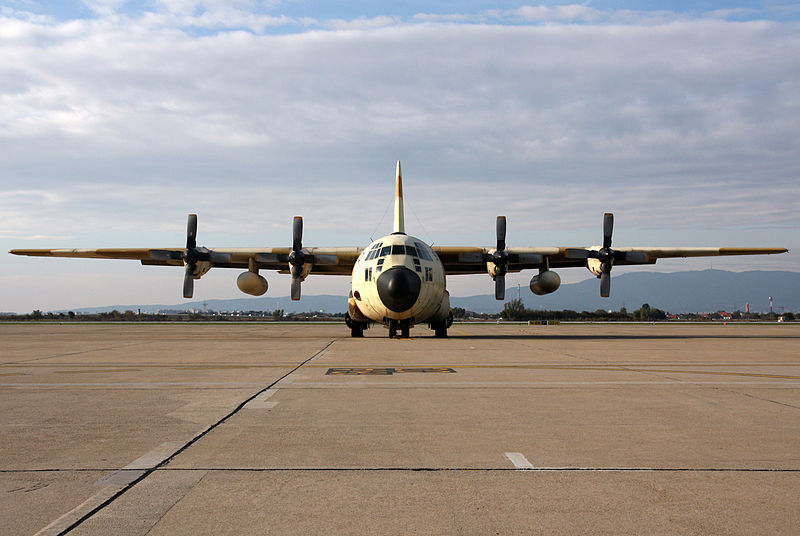
C-130H Hércules
Mulag, CC BY-SA 3.0, via Wikimedia Commons
Hyperlinks:
...
...
...
 Gabriela Ramos
Gabriela is the latest addition to the editorial team of our website, having provided us with her solid background in editing, publishing and photography, and her interest and training in aviation history and historiography. His good taste and common sense and great cleverness and sagacity in the selection of themes and materials greatly enriched our vocabulary and narrative style. Gabriela brought unusual predicates and came to stay, helping to point the way of success of our portal.
   
|