Aviation
Military /
Europe
Replacement for the F-5
The F-35 is likely to be the next Swiss Air Force fighter, according to Swiss media
F-35
U.S. Air Force photo by Master Sgt. Donald R. Allen, Public domain, via Wikimedia Commons
Gabriela Ramos
6/28/2021
According to the SRF (German Swiss Radio and Television) last Monday, 21, the F-35 fighter would have won the race to replace the fighters currently operating by the Swiss Air Force: the F-5 Tiger and F / A -18C / D Hornet.
According to independent sources, “both financially and technically, the stealth jet is well ahead of the F/A-18 Super Hornet, the Eurofighter and the Rafale. Defense Minister Viola Amherd (Die Mitte), therefore, has no choice but to ask the Federal Council to buy the F-35. The DDPS [Federal Department of Defense, Civil Protection and Sport] itself refuses to comment and refers to the secrecy of the Federal Council's business. According to sources, preparations for the long-awaited decision of the Federal Council are well advanced. A press release had already been written about the purchase of the F-35 project - but the entire Federal Council could still decide otherwise”.
The “Air 2030” program was launched by Switzerland to select its future fighter after a referendum rejected the acquisition of the Saab Gripen in 2014 to replace the F-5E. In the program, four fighters were evaluated: the Eurofighter Typhoon, the Boeing F / A-18 Super Hornet, the Dassault Rafale and the Lockheed Martin F-35. The Gripen E ended up not entering the test, as the Swiss purchasing agency only wanted to evaluate aircraft that were operational in 2019, having “formally recommended” to Saab that it stay at home.
In January 2020, Armasuisse (Federal Defense Procurement Office) issued the second RFQ for new fighter jets to government authorities in Germany, France and the United States, countries where the four potential suppliers are located (Airbus Eurofighter, Dassault Rafale, Boeing and Lockheed Martin).
“The second request for proposal is based on analysis of the first proposal and flight, simulator and ground test results, as well as audits with the armed forces operating the evaluated fighters. In the second request for proposal, companies contacted through government authorities are asked to submit the most advantageous offer for Switzerland. The proposal must include the following elements: prices for 36 and 40 aircraft, including defined arms and logistics, as a binding starting point for detailed negotiations with the selected candidate after type selection; offers of cooperation between the armed forces and purchasing authorities of Switzerland and the supplier country; compensation projects planned or already started”, he highlights. In September of the same year, a $6.49 billion financing package was approved for the Swiss Air Force to proceed with the purchase of the new fighter jets.
The F-35, then, appears to have shown the Swiss Air Force that it has advantages over the other three competitors, despite the known controversies and problems. The advantage would be not only technical, but also in terms of cost, since with $6.49 billion the Air Force could buy more F-35s than any other fighter among competitors.
In addition, another reason for the alleged success of the F-35 in Switzerland would be its simulator, which allows the Air Force to carry out more training missions than it could with other competitors. Many countries are betting on LVC (Live Virtual Constructive), which, through virtual reality and simulators, allow the interconnection of aircraft in flight with ground simulators, creating a variety of complex scenarios involving CGF (Computer Generated Forces).
According to Colonel Marzinotto, commander of the 32nd Stormo (Italian Air Force unit, the first to operate the F-35 in Europe), “The F-35 is ready for the LVC. However, at this time, there are cybersecurity criteria and operational relevance considerations that make its use premature: it is a segment that has not reached the level of maturity necessary to be operationally employed. In the future, the need to connect in-flight aircraft and simulators will be reconsidered, but for now these hybrid scenarios are not part of the training process for Italian F-35 pilots.” It is not yet known if the simulator system used by the Italian Air Force is the same one presented to the Swiss Air Force or if it is an updated version that would have reached the “level of maturity” expected by the Italians.
The new Swiss Air Force fighter is expected to be officially announced by June 30 of this year, with delivery scheduled to take place between 2025 and 2030.
However, according to the SRF, two of the seven Federal Council members said they would prefer a European fighter such as the Eurofighter or the Rafale, and critics have vowed to launch a referendum against US aircraft purchases as they fear there is no guarantee of data security. In other words, the decision is not just about technical characteristics. Even so, despite the positioning of these two members, the decision will be taken by the entire Federal Council.
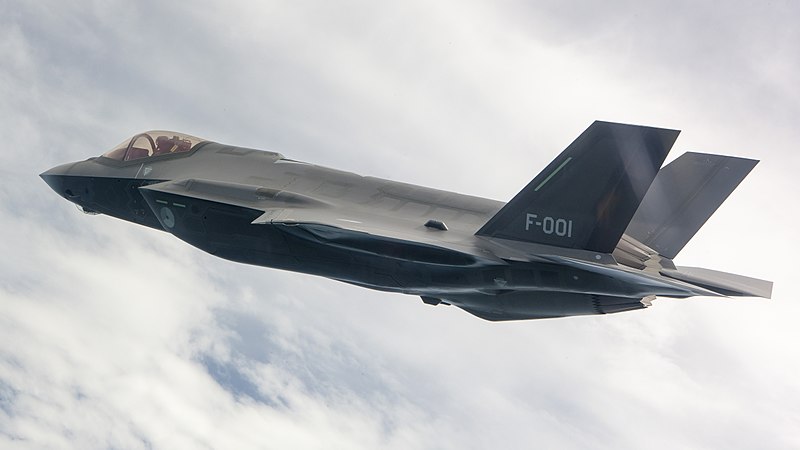
F-35
US Air Force / Ministerie van Defensie, CC0, via Wikimedia Commons
Hyperlinks:
...
...
...
 Gabriela Ramos
Gabriela is the latest addition to the editorial team of our website, having provided us with her solid background in editing, publishing and photography, and her interest and training in aviation history and historiography. His good taste and common sense and great cleverness and sagacity in the selection of themes and materials greatly enriched our vocabulary and narrative style. Gabriela brought unusual predicates and came to stay, helping to point the way of success of our portal.
   
|