Aviation
Military /
Europe
F-35 no way
The American jet would never be a match for an Eurofighter Typhoon, says Italian test pilot
Eurofighter Jagdflugzeug GmbH
Royal Air Force Typhoon F-2
By Chris Lofting - http://www.airliners.net/photo/UK---Air/Eurofighter-EF-2000-Typhoon/1189137/L/, GFDL 1.2, https://commons.wikimedia.org/w/index.php?curid=20654565
José PEDRO Magalhães Ramos
7/8/2021
Billy Flynn, Lockheed Martin test pilot responsible for testing the F-35 fighter, said all three variants of this aircraft would have kinematic performance equal to or better than any fourth-generation fighter aircraft equipped with a typical combat load, including the Eurofighter Typhonn. It should be noted that in the Red Flag Alaska exercises carried out in 2020, Typhon managed to obtain numerous simulated victories against the supposedly unbeatable F-22 and against the F/A-18E Super Hornet.
In terms of instantaneous turn ratio and sustained turn, as well as any other metric imaginable, the F-35 significantly matches or exceeds the capabilities of any fourth-generation fighter, Flynn said. According to the Lockheed pilot, in addition to stealth, the F-35 has better transonic acceleration and superior flight performance at high AOA (angle of attack) compared to a Typhoon or a Super Hornet armed with a typical gun load. combat.
This information however is heavily contested by many sources. It is a more or less common belief of many that the F-35 is inferior in air combat to fourth-generation fighters such as the F-16, Rafale, Typhoon or the Russian-generation 4 fighters.
Among the voices that have risen loudly against the debatable claims of the lockheed Martin test pilot is the Eurofighter Typhoon test pilot. In a note sent by the pilot to The Avionist website he says:
Without a doubt, the f-35 will, when available, be a very capable aircraft. Its stealth design, extended range, internal payload capability and a variety of built-in sensors are definitely successful ingredients in modern ground attack operations.
However, when it comes to air superiority, other ingredients such as thrust-to-weight ratio and wing load tend to be the regulators of the sky. And in this Field nothing comes close to Typhoon except an f-22 which has very similar values.
The F-35's weight-thrust ratio is much lower and its energy-maneuverability diagrams match those of the F/A-18 which is an excellent result for a single-engine plane loaded with several thousand liters of fuel. and weaponry.
But it also means that starting in combat at medium altitude or above he doesn't stand a chance against a Typhoon loaded with an equivalent weapon charge.
TRANSONIC ACCELERATION
Transonic acceleration is excellent on the F-35 as well as the Typhoon and is better than the F/A-18 or 16, but mainly because of its low drag characteristics rather than its propulsion.
This means that immediately after the transonic regime the F-35 will stop accelerating and constantly struggle to maintain a 1.6 mach that is not operationally sustainable. The Typhoon will continue accelerating in supersonic mode with an impressive constant thrust, giving more range to its BVR (beyond visual range) weaponry.
HIGH PERFORMANCE AOA (ANGLE OF ATTACK)
Angle of attack is remarkably high on the f-35, as for any double-tailed aircraft, but it certainly cannot be exploited in supersonic regime when load factor limitation is already reached at low AOA values. Also in subsonic regime the angle of attack alone doesn't mean much especially if after a modest 12 degrees of AOA you will literally fall out of the sky.
The excessive power loss ratio [by high AOA] would operationally limit the F-35 well before its AOA limit is reached. The Eurofighter's engine-fuselage assembly in combination with its high "high-boresight" armament (firing capability not in line with the aircraft's nose) supported by a movable helmet-mounted sight has consistently proven to be victorious against any agile fighter.
Finally, the F-35 is capable of carrying bombs in supersonic regime in the bomb bay, but the fuel penalty makes this practically unreachable as the delivery of weapons at subsonic speeds is practically a limitation of the weaponry itself, as is the case with the Typhoon .
In conclusion, if in fact the Typhoon can do most of the F-35's ground attack missions, vice versa the F-35 remains far from a true anti-aircraft capability, let alone if we talk about regulating the skies or or air domination.
As long as the f-35 is able to solve all its problems and the rising costs do not lead to a deadly spiral of unit cuts, both the RAF and the Italian Air Force will have both aircraft models in their fleets.
Simulated air combat training will then show which aircraft is superior.
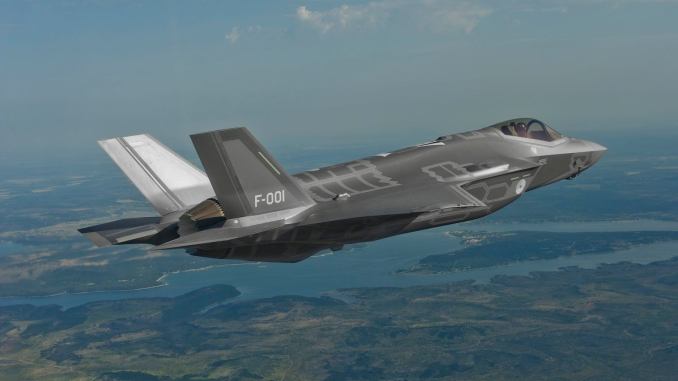
Lockheed Martin
F-35
LM Photo
Hyperlinks:
 José PEDRO Magalhães Ramos
He is a professional with almost four decades of experience in aviation. Having worked at Rio Sul and TAM in the 1980s and in the 1990's, joined Vasp where he spent 10 years in the Engineering area. He then created and operated the website www.aerospace.com.br for 4 years, now extinct and in 2004 he joined Gol, having stayed until 2017 and passed in various technical and business areas. Currently as a technical consultant still-and always-in the aviation area, he dedicates his private time to create and operate this our portal!
   
|