Aviation
Commercial /
Asia
Boeing 737 Max
China advances in recertification but return of Boeing's most famous narrow-body twin could take time
Boeing
Max high performance climb
Por Oleg V. Belyakov - http://spotters.net.ua/file/?id=110706&size=large, CC BY-SA 3.0, https://commons.wikimedia.org/w/index.php?curid=58804815
José PEDRO Magalhães Ramos
7/14/2021
A lot of interesting private information regarding the return to operations of the Boeing 737 Max in China leaks out this week and appears to be positive for Boeing and for the normalization of operations of its most famous twin-engine, the Boeing 737 model Max.
No fewer than 35 test pilots will be part of a team that, together with the Chinese regulatory authority, will plan the activities and test flights that will culminate in the aircraft's return to operations.
However, it is speculated that this time may be quite extended especially compared to many other countries that are already operating Max normally.
Authorities in China have expressed severe concerns about the Max's safety and the quality of changes implemented by Boeing and the FAA to ensure that the plane is safe, and that the problems that led to the two accidents that marked the start of its operations and that traumatized commercial aviation around the world are overcome.
POLITICAL PROBLEM
However, there are those who guarantee that there are geopolitical interests at stake and that the growing tension between China and the United States may be causing the Chinese to make it difficult for US aircraft to resume flight.
The geopolitical game is heavy. China is investing heavily to develop its own aeronautical technology in the area of commercial aviation. Its main projects are the C919, a narrow body, and the C929, a wide body. These aircraft are expected to be able to operate with North American engines as China has not yet mastered the technology of building commercial aero engines.
With the intensification of disputes between the two countries, China certainly sees the possibility of being restricted in its intention to access US civilian propulsion units.
Observers suspect that creating barriers to the Max's return could help tip the balance of negotiations towards China on the issue of making possible future engines of the C919 and C929 available to the Chinese who will, after all, use these aircraft. to compete in the commercial aviation market against European and North American manufacturers.
FLIGHT TESTS
It is not clear whether China really intends to carry out real flight tests as a step to recertify the Max. These flight tests were not unanimously agreed by all countries and jurisdictions that have already authorized the resumption of twin-engine operations.
The main certifying agencies, especially the FAA and EASA, carried out real in-flight tests. But China's attitude is still uncertain and some say that the Chinese authority can simply validate the recertification work carried out by the FAA, as is often customary in aeronautical certifications, that is, when a state trusts the technical quality of the certifying authority from another state, there is no need to repeat the entire certification program again, it is enough, through criteria and bilateral agreements between the states involved, to endorse the certification of the state of origin.
However, given the suspicion that geopolitical factors may be present, it is not certain that this path will be followed.
Boeing has a special interest in having China flying the Max again and has already sent delegations to the country with this in mind, but it is not known what result this approach may lead to. Boeing's position is delicate. Sources have mentioned that its executives fear that the extension of the grounding will affect the American manufacturer's plans to return to full normality of its production and stabilization of its revenues, heavily dependent on the sales of the Max, which, after all, is the most popular jet from Boeing and one of the most popular in the world, only competing with the A-320, from Airbus.
The difficulties created by the shutdown of the American jet, however, are not only concerns for the Seattle-based manufacturer. The US government has reason to be concerned and appears to be showing signs of participating in the pressure to resume operations through its political and diplomatic channels. Commerce Secretary Gina Raimondo made it clear that the US is "absolutely working" for it (she had pressured China to accept the jet's return) when giving an interview to Bloomberg in June. After all, Boeing's position as an exponent of the world's commercial jet manufacturing is capital for the US, which will "relinquish global leadership" - in the words of Dave Calhoun, Boeing CEO - in commercial aviation and with this it will still suffer strong impacts in its trade balance and mastery of technological primacy - or at least in its ability to continue to compete effectively with Airbus, which would be a huge setback for the nation of Uncle Sam.
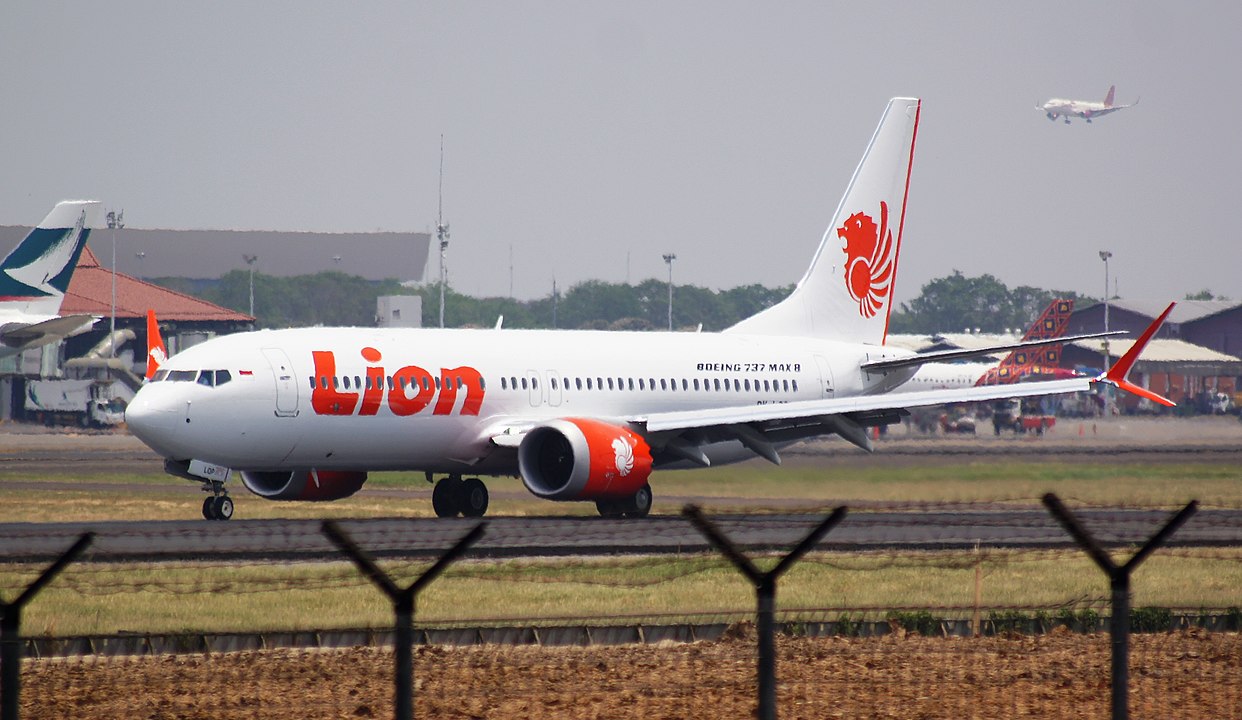
Lion Air
This is the first Max model that crashed in Sep. 2018, PQ-LQP, Lion Air 610.
Por PK-REN from Jakarta, Indonesia - Lion Air Boeing 737-MAX8; @CGK 2018, CC BY-SA 2.0, https://commons.wikimedia.org/w/index.php?curid=73958203
Ethiopian Airlines
This is the second Max model involved in a fatal crash, ET-AVJ, FLight 302
Por LLBG Spotter - Ethiopian Airlines ET-AVJ takeoff from TLV, CC BY-SA 2.0, https://commons.wikimedia.org/w/index.php?curid=77232751
Hyperlinks:
 José PEDRO Magalhães Ramos
He is a professional with almost four decades of experience in aviation. Having worked at Rio Sul and TAM in the 1980s and in the 1990's, joined Vasp where he spent 10 years in the Engineering area. He then created and operated the website www.aerospace.com.br for 4 years, now extinct and in 2004 he joined Gol, having stayed until 2017 and passed in various technical and business areas. Currently as a technical consultant still-and always-in the aviation area, he dedicates his private time to create and operate this our portal!
   
|