Aviation
Commercial /
Europe
sustainable aviation
Researchers present the concept of a new turboelectric aircraft
Divulgação/Bauhaus Luftfahrt
Gabriela Ramos
8/5/2021
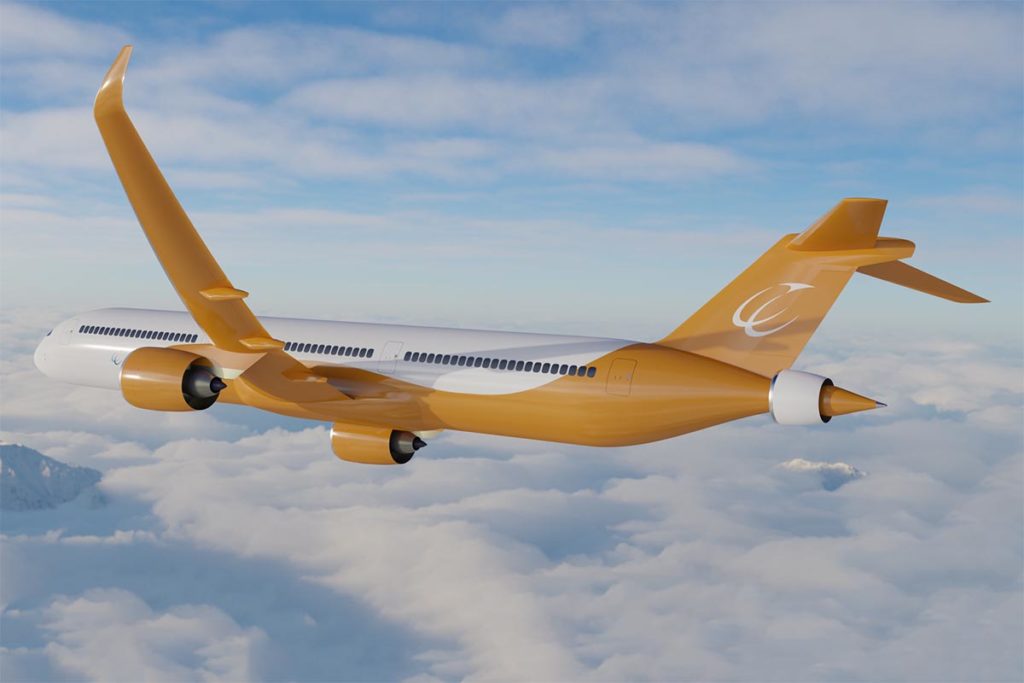
A team of researchers from the Bauhaus Luftfahrt eV announced, after nearly four years of research, the so-called Propulsive Fuselage Concept (PFC), a commercial turbo-electric aircraft that could be fundamental to the development of more sustainable aircraft. The jet will be able to carry 340 passengers and will produce 4.7% less CO2 emissions compared to a conventional aircraft.
The aircraft will have two gas turbines in the wing engines, in addition to an electric fan located at the rear, which will exploit the so-called "wake-fill", an energy source, little used in aircraft, which produces a thrust when ingesting and re-energizing the air flow around the fuselage. Furthermore, the configuration of the aircraft will be compatible with other advanced technologies, such as sustainable fuel use.
According to the researchers, the “wake-fill” is already well known in the field of maritime propulsion and, as proved by the eleven partners from six European countries participating in the project, it could also be applied to airborne propulsion.
Arne Seitz, project coordinator at Bauhaus Lufthart eV, said: “We have successfully tackled the immediate challenges that are associated with integrating the 'wake-fill' propulsion into the fuselage. With the proof of concept carried out, we take this technology to the next level. Our achievement could represent an important stepping stone in the way of inserting the 'Propulsive Fuselage' for a possible development of aircraft products in the future”.
The benefits of wake-fill were tested under realistic design and operation conditions, and through computer simulations, fan tests and low-speed wind tunnels, a complete understanding of the aerodynamic effects of propulsion was gained. The design and analysis results were integrated into a pre-design aircraft family and the technology was compared to an equally advanced aircraft.
The evaluation was carried out considering the air transport of 340 passengers and 12 thousand kilometers of range in the year 2035. The study showed a reduction of 4.7% in CO2 emission by the turboelectric engine compared to more advanced aircraft or a reduction of 36 % compared to the year 2000 baseline.
Nitrogen oxide (NOx) emissions during the take-off and landing cycle show a reduction of 1.8% compared to the 2035 baseline and 41% compared to the 2000 baseline. NOx emissions by 20% and 64% compared to the year 2035 and 2000 standards, respectively.
The CENTERLINE project is coordinated by Bauhaus Luftfahrt, and the consortium is made up of eleven partners from six European countries, with four important partners, such as Airbus Defense and Space, Airbus Operations, MTU Aero Engines, Rolls-Royce and Siemens, in addition to from four leading European universities: Chalmers University of Technology, Delft University of Technology, University of Cambridge and Warsaw University of Technology, with the support of management consulting partners ARTTIC Innovation GmbH and ARTTIC SAS. The initiative received funding of 3.7 million euros by the European Union.
The video in the link below shows the vision of the research team on what it will be like to fly in 2035.
Divulgação/Bauhaus Luftfahrt
Hyperlinks:
https://www.youtube.com/watch?...
...
...
 Gabriela Ramos
Gabriela is the latest addition to the editorial team of our website, having provided us with her solid background in editing, publishing and photography, and her interest and training in aviation history and historiography. His good taste and common sense and great cleverness and sagacity in the selection of themes and materials greatly enriched our vocabulary and narrative style. Gabriela brought unusual predicates and came to stay, helping to point the way of success of our portal.
   
|