Aviation
Military /
China
Competitor of the F-22
Find out why China's J-20 fighter is prohibited for sale
J-20
Alert5, CC BY-SA 4.0, via Wikimedia Commons
Gabriela Ramos
8/8/2021
China's J-20 stealth fighter, considered by many to be the equivalent of the US F-22 – and even superior in some respects – is an aircraft that is currently blocked from being exported. That's because China fears its fifth-generation technology will fall into the wrong hands, according to Song Zhongping, a former official with China's Missile Force Second Artillery, in a 2014 interview with Chinese TV Phoenix.
In addition, Zhongping also stated that unless the United States sold the F-22 to its allies, it would have no need for China to export its J-20 fighter to its allies and that, since the United States only provided the its allies the less capable F-35, so China would export to its allies only the FC-31, which is supposedly equivalent to the F-35 in terms of technology and performance.
In addition to the fear of having its technology dissected and copied, China appears to have another reason for not wanting to export the J-20: to avoid an arms race in fifth-generation technology between its allies and the United States.
But it's not just these reasons. There are other, more practical reasons why Beijing prefers not to speak publicly.
On the international market, China's military industry has performed very poorly despite two decades of massive investment in defense-related research. Chinese exports from this sector were mostly of relatively simple items such as armored vehicles, transport aircraft, artillery, patrol boats and light weapons. In 2020, China's arms exports accounted for only 5.2% of the total international arms trade. The Chinese military aviation industry performed even worse.
China's main export fighter will be the JF-17, until the FC-31 is fully operational, which should be within the next three years. However, the JF-17's market success was moderate. Despite having been present for more than a decade, its only customers are Pakistan, with 138 aircraft, Myanmar, with seven, and Nigeria, with three.
Although the JF-17 is cheaper than most similar fighters and, in addition, China generally offers flexible means of payment, the country still finds it difficult to sell its fighters. It appears that the world's air forces are not convinced that Chinese fighters are of quality, and only sanctioned countries with limited resources buy from China, even with significant advances in aviation technology.
Thus, Zhongping's explanation of why China has not been exporting the J-20 appears to be just advertising aimed at the domestic audience. Thus, by saying that it will not export the J-20, China puts it on an equal footing with the F-22 and, by stating that it will only export the FC-31, the country equals it to the F-35.
However, the F-35 is a commercially successful fighter, with more than 665 aircraft currently operating in 15 countries, and was recently chosen by the Swiss Air Force as a new fighter jet on a $6.5 contract. billion. The FC-31 will hardly have a similar sales success.
Also, there are other issues involved, such as the use of Russian technology. The J-20 and FC-31 make use of Russian technologies and theoretically cannot therefore be exported without Russian consent.
And that also raises a question for some military personnel: it might make more sense to buy directly from Russia rather than from China. In 2015, China itself bought 24 Russian Su-35 fighter jets for $2 billion.
As such, it appears that the real reason China has not shown interest in exporting the J-20 is that it will probably not be well accepted worldwide and chances are that the FC-31 will not show a better performance.
So despite its significant advances and improvements in fighter technologies, China appears to suffer from an image problem.
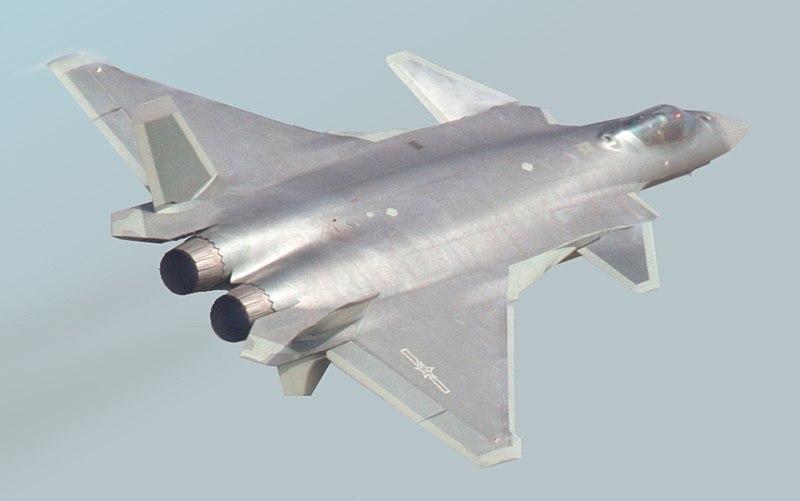
J-20
Alert5, CC BY-SA 4.0, via Wikimedia Commons
Hyperlinks:
...
...
...
 Gabriela Ramos
Gabriela is the latest addition to the editorial team of our website, having provided us with her solid background in editing, publishing and photography, and her interest and training in aviation history and historiography. His good taste and common sense and great cleverness and sagacity in the selection of themes and materials greatly enriched our vocabulary and narrative style. Gabriela brought unusual predicates and came to stay, helping to point the way of success of our portal.
   
|