Aviation
Military /
China
Intimidating Taiwan?
China uses Cold War J-7 fighters to conduct strike exercises close to the asian island
Iran Air Force Chengdy J-7
Shahram Sharifi, CC BY-SA 3.0, via Wikimedia Commons
Gabriela Ramos
8/8/2021
Since September 2020, when Taiwan began tracking and publishing military exercises, China has carried out more than 170 incursions into the island's airspace. In June, Taiwan's Air Defense Identification Zone (ADIZ) was breached by Chinese aircraft ten times. In July there were seven incursions and this number has increased. According to Taiwan's Ministry of National Defense, since September last year there have been more than 170 Chinese incursions into ADIZ.
On June 15, 28 PLA (People's Liberation Army) aircraft entered Taiwan's airspace. On the 17th of the same month, four Cold War-era fighter jets, the Chengdu J-7, nicknamed “Grandfather's fighter planes” by Taiwan, entered the island's airspace, along with a J-16 and a Y- 8, surprising experts, who had hoped to see the most advanced Chinese aircraft.
The J-7 is a second-generation Cold War-era fighter, and had its maiden flight in 1966. It has a maximum speed of Mach 2 and until the end of the Cold War was the longest-range and fastest Chinese aircraft, playing a role of absolute air superiority. Several variant versions were manufactured, used by other air forces such as Pakistan and Bangladesh. It is estimated that more than 2,400 models have been produced. The jet's production ended in 2013, but to this day it is still the most exported fighter jet in China, with a presence in 17 countries.
There was much speculation as to why China sent the former J-7s to Taiwan, and military experts explained that this could be an exercise in siege to the island. In addition, military sources also debated the possibility that the aircraft were unmanned and turned into drones, but this possibility was denied by the Taiwan Air Force, which said they were real J-7s and not drones.
Debates over the possible conversion of the J-7 to drones have been driven by reports suggesting that China has turned thousands of decommissioned fighter units into drones, as well as other fighter models such as the Q-5, J-6 and J -8.
Ben Ho, air force analyst at the S Rajaratnam School of International Studies, stated that “the PLA would do well to take a page from the Azerbaijani manual and likewise use the J-7 as an unmanned bait for SEAD [deletion of enemy air defense] during a regional emergency,” referring to the Nagorno-Karabakh conflict, in which Azerbaijan won military victory using drone strikes against Armenia.
Another group of experts believes that the J-7s converted to drones could be testing the Taiwan Air Force's response to check that all of its aircraft were flying again.
According to the Global Times, Chinese experts said the exercise with the J-7s showed the PLA's high level of preparedness and control over the region, demonstrating that its older aircraft could also play a role. Song Zhongping, China's military expert, stated that "they [the J-7s] can be equipped with advanced air-to-air missiles and mission pods to become competitive even today, and can also be modified into unmanned versions."
However, a Global Times report suggested that the PLA would be considering phased out its J-7 fleet, replacing them with more advanced next-generation fighter jets.
With China's declaration to increase its defense budget by 6.8% in 2021, it is assumed that the former J-7 fleet will be replaced by third and fourth generation fighters such as the J-20, which is the most recent addition to the mighty Chinese air force.
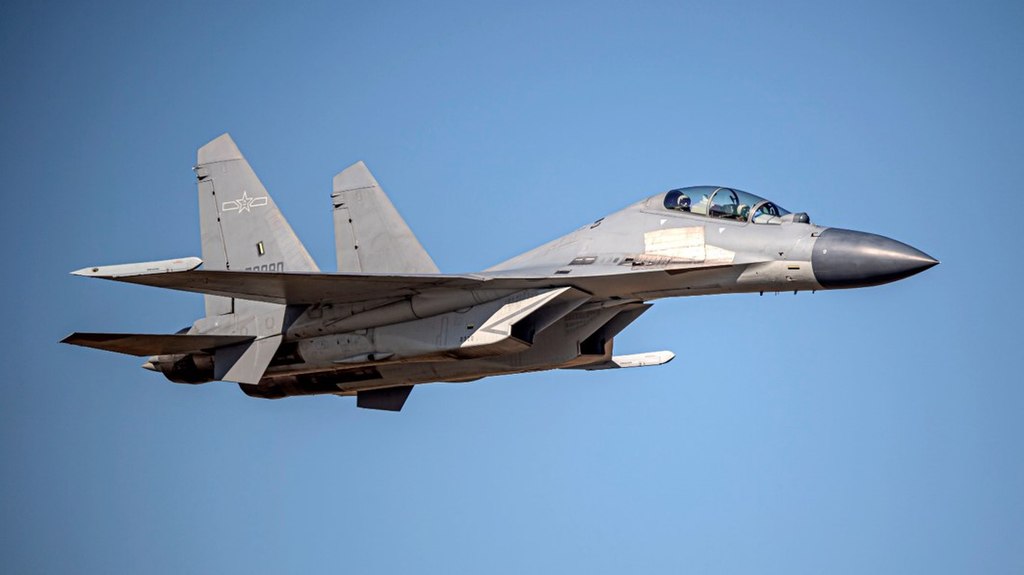
J-16
Ministry of National Defense, Attribution, via Wikimedia Commons
Hyperlinks:
 Gabriela Ramos
Gabriela is the latest addition to the editorial team of our website, having provided us with her solid background in editing, publishing and photography, and her interest and training in aviation history and historiography. His good taste and common sense and great cleverness and sagacity in the selection of themes and materials greatly enriched our vocabulary and narrative style. Gabriela brought unusual predicates and came to stay, helping to point the way of success of our portal.
   
|