Infrastructure
airports /
Brazil
Practicality
Face recognition for boarding is tested on crew at Congonhas Airport
image: Infraero
Rafael Ramos
11/20/2021
Aiming at more convenience and security on boarding, after the airports in Brasília and Ribeirão Preto, Congonhas Airport, in São Paulo, tests the boarding by facial recognition. Initially, the tests that are part of the Federal Government's 100% digital Safe Shipping program are carried out on Azul, Gol and Latam pilots and flight attendants.
“Between October 2020 and September 2021, we carried out boarding tests using biometric facial recognition of passengers. We are now starting a new stage, with the crew, in which we combine two disruptive technologies at the same time: the crew's digital card and the biometric recognition of Safe Boarding”, explains the National Secretary of Civil Aviation, Ronei Glanzmann.
The program was conceived by the Ministry of Infrastructure (MInfra) and by the Special Secretariat for De-bureaucratization, Management and Digital Government of the Ministry of Economy. The technology also has the contribution of important government institutions, such as the National Civil Aviation Secretariat (SAC), the National Civil Aviation Agency (Anac), Infraero, airlines, airport operators and information technology companies.
The purpose of the process is to make the entire boarding more efficient, agile and safe by avoiding the presentation of travelers' documents when accessing the boarding lounge and aircraft. This is not the only time the technology will be used, as the federal government intends to expand facial recognition and biometrics to other public services.
The testing phase should last 15 days and can be extended. The test must also be applied at Santos Dumont Airport, in Rio de Janeiro. The negotiations for the definitive implementation of biometric boarding are advanced, and the technology could be present at the country's airports as early as 2022.
The following text, available on the Infraero website, explains how biometric boarding works:
At the time of access control to the Restricted Security Area (ARS), a biometric reading equipment collects the crew member's facial reading and validates the biometric parameters with the CHT Digital database (crew identification document), confirming that the individual is a civil aviation crew member and the validity of the document.
In case of positive biometric identification, the crew member will have access to the airport ARS without the need to present documents for access, avoiding contact between the crew member and the physical access control agent to the documents (touchless procedure).
If not, the crew member's CHT and the air operator's identification document may be manually verified and validated by an airport operator's agent responsible for controlling access to the ARS. The access control procedure, through facial biometrics, does not exempt the crew from submitting to airport security inspection.
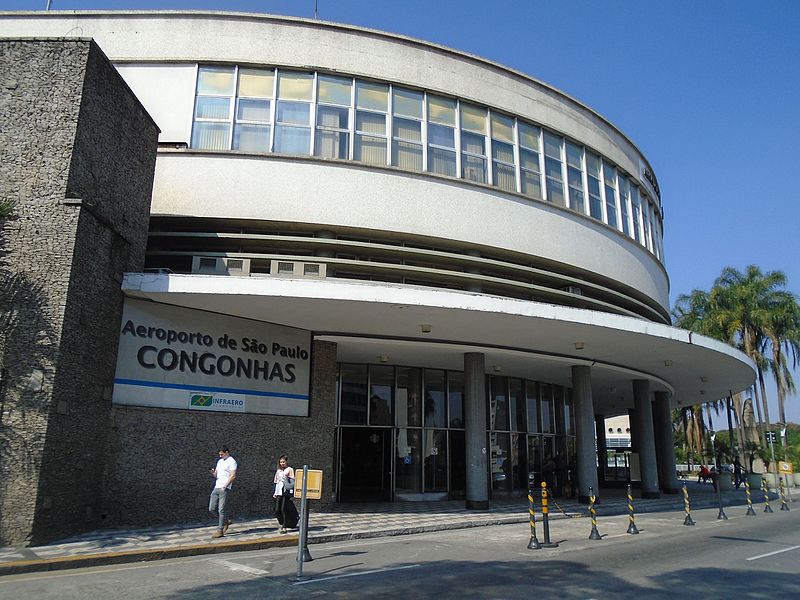
Congonhas Airport
CC BY-S.A 4.0
Hyperlinks:
...
...
...
 Rafael Ramos
Aviation enthusiast from an early age, he had his first contacts with the area developing that good old habit of spending dozens of hours in front of the screens of Micrsoft Flight Simulator and other simulators. With a solid background in various technological areas, including engineering and chemistry, Rafael has rejoined aviation as editor and author of articles and materials on our portal, providing invaluable help to the dynamics and expansion of the website and the aeronautical community, bringing us the news and updates so indispensable for us to remain current in our area of operation.
   
|